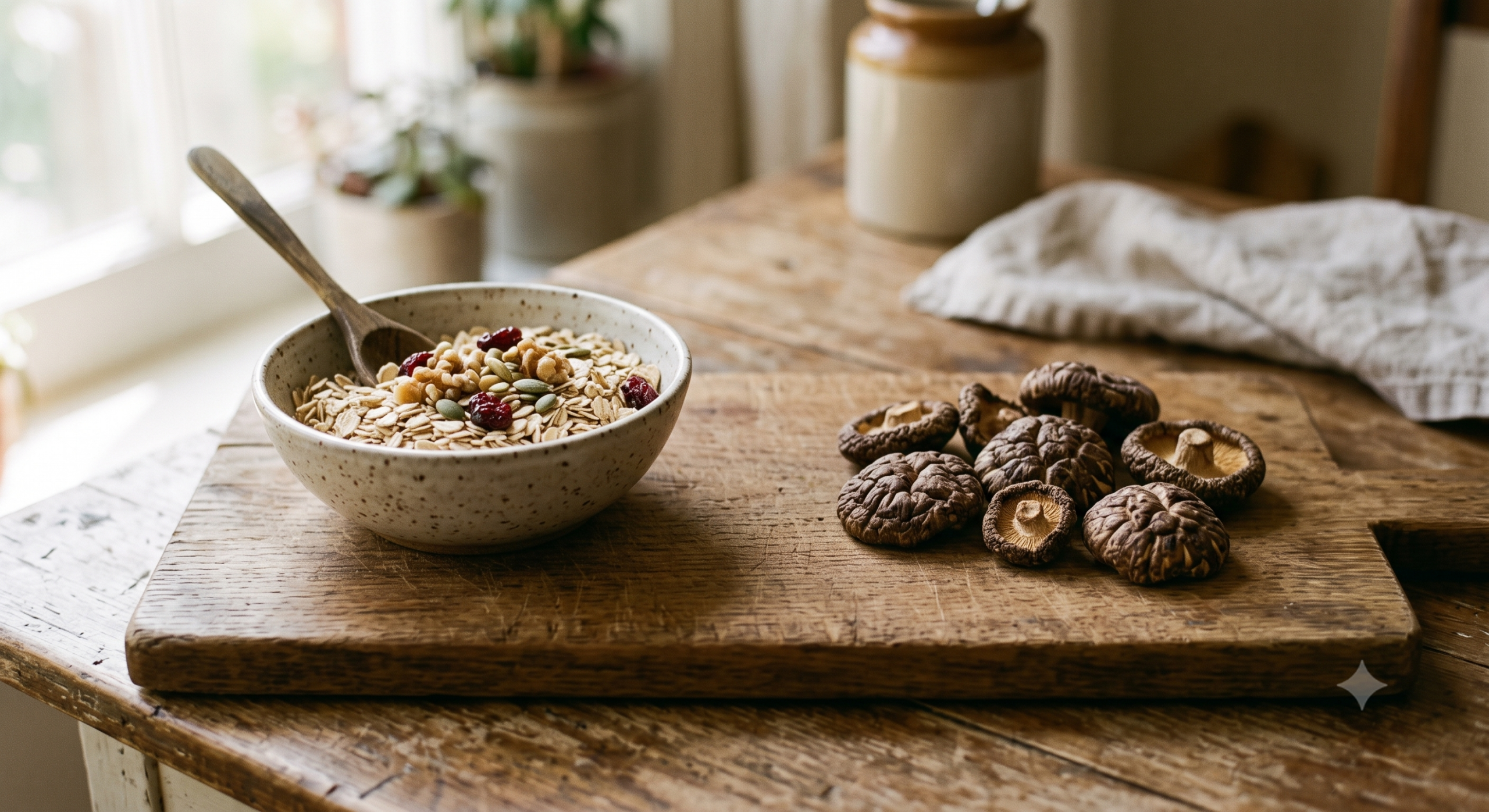
Beta-glucan appears on two entirely different kinds of product — cholesterol-lowering oat foods and immune supplements.
That isn’t marketing stretching one ingredient across two categories. They’re different molecules doing different things, and the difference comes down to how the glucose units are joined.
Two structures, two mechanisms
Beta-glucans are chains of glucose. What varies is where the links sit.
Cereal beta-glucan (oat, barley) uses β-1,3 and β-1,4 linkages[1][4]. This produces a soluble fibre that forms a viscous gel on contact with water[6].
Fungal and yeast beta-glucan (mushroom, baker’s yeast) uses β-1,3 and β-1,6 linkages[4]. The 1,6 links create branches off the main chain[3].
That structural difference determines everything downstream.
| Oat / barley | Yeast / mushroom | |
| Linkages | β-1,3 / β-1,4 | β-1,3 / β-1,6 |
| Shape | Linear, gel-forming | Branched |
| Mechanism | Viscous gel in the gut | Binds immune receptors |
| Best-evidenced use | LDL cholesterol, post-meal glucose | Immune modulation |
| Typical dose | 3 g/day | Milligram range |
[Table 1] The two classes compared · Source: Compilation of relevant literature[1][4][6]
Why oat beta-glucan lowers cholesterol
The mechanism is physical rather than biochemical.
In the small intestine the viscous gel slows gastric emptying, traps bile acids, and slows glucose absorption[1].
Trapping bile acids is the key step. Bile acids are made from cholesterol. When they’re bound in the gel and excreted rather than reabsorbed, the liver must pull cholesterol from the bloodstream to make new ones[4] — which lowers circulating LDL.
The effect size is established. Meta-analyses of more than 50 randomised trials found 3 g/day of oat beta-glucan reduces LDL by approximately 0.3 mmol/L (12 mg/dL)[4].
Note that this requires the gel to form. The mechanism depends on viscosity, not on the molecule reaching the bloodstream — which is why the dose is in grams rather than milligrams.
Why fungal beta-glucan doesn’t
The branched form works by a completely different route: it is recognised by immune receptors.
β-1,3/1,6-glucan binds Dectin-1 and complement receptor 3 (CR3) on macrophages, neutrophils and natural killer cells[4][5].
Dectin-1 is a pattern recognition receptor — part of how the innate immune system identifies fungi. Fungal cell walls contain beta-glucan, so the receptor evolved to detect exactly this structure.
The comparison is direct. Yeast-derived β-1,3/1,6-glucan activates Dectin-1 more potently than cereal-derived β-1,3/1,4-glucan[5].
And there’s a structural threshold. Only highly purified β-1,3/1,6-glucans with a high degree of branching and a high molecular weight are able to exert immunomodulatory properties[2].
So within the fungal class, not every preparation qualifies. Branching density and molecular weight both matter.
Mushroom beta-glucans don’t lower cholesterol or directly affect blood sugar[6]. Their mechanism is entirely immunological — they lack the linkage pattern that makes oat beta-glucan form a gel.
Even within fungi, the structures differ
A finer distinction worth knowing.
The β-1,6 side chains are short and spaced in fungal species such as mushrooms, and longer in yeast species[2].
So “yeast beta-glucan” and “mushroom beta-glucan” aren’t interchangeable either, despite sharing the 1,3/1,6 designation.
A bit more detail — on why more branching isn’t always better. One analysis notes that efficacy may diminish at higher doses of yeast-based beta-glucans, possibly because β-1,6 side chains sterically interfere with one another and hinder access to the Dectin-1 receptor[7]. If correct, the branches that enable receptor binding can also obstruct it at sufficient density. This remains a proposed explanation rather than an established one, but it illustrates why structure-activity relationships in this family aren’t simply linear.
Regulatory status diverges too
The two classes sit in different regulatory positions, which follows from the evidence.
Oat and barley beta-glucan carries authorised health claims in the UK for blood cholesterol maintenance at at least 3 g daily, and for post-meal blood glucose response at 4 g per 30 g available carbohydrate[1]. A separate reduction-of-disease-risk claim permits stating that oat beta-glucan lowers blood cholesterol at 3 g daily[1]. The FDA has approved a heart disease risk claim for oat beta-glucans[3].
Mushroom and yeast beta-glucan occupies a different category. No UK or EU food-supplement-tier health claim is authorised for them, despite a substantial cell-biology literature on Dectin-1 signalling[1].
That gap is worth reading carefully. It doesn’t mean the immune mechanism is fictional — the receptor binding is well documented. It means the regulatory bar for a claim about human outcomes hasn’t been met.
Which is the same distinction covered throughout this series: a demonstrated mechanism and an authorised claim are different things.
What to check on a label
- Identify the source. Oat, barley, yeast, or mushroom. This determines which mechanism applies.
- Check the dose against the mechanism. Oat beta-glucan needs grams to form enough gel. A product supplying milligrams of oat beta-glucan isn’t delivering the studied amount.
- For fungal sources, look for purity and molecular weight information. Only highly purified, highly branched, high-molecular-weight preparations showed immunomodulatory activity in the literature[2].
- Don’t transfer claims across sources. Cholesterol evidence belongs to the cereal form; immune evidence belongs to the fungal form. Neither carries over.
- Check the approved wording where you are. Recognised functional claims differ by jurisdiction and are checkable on the official portal[8].
- If you take diabetes medication, note that beta-glucan blunts post-meal glucose, and additive effects with medication warrant monitoring[4].
Closing
This is the cleanest example in the series of a name covering two different things.
One beta-glucan works by being physically viscous — it never enters the bloodstream, and its dose is measured in grams because the gel has to be substantial enough to trap bile acids. The other works by being shaped like a fungal cell wall, which is what an immune receptor evolved to detect.
The linkage difference — 1,4 versus 1,6 — is the whole story. It determines shape, and shape determines whether the molecule forms a gel or fits a receptor.
Which makes “beta-glucan” on a label almost uninformative on its own. The source is the ingredient; the shared name is a chemical family, not a product description.
Key Terms
- Beta-glucan — a family of glucose polymers found in cereal, yeast and fungal cell walls.
- Glycosidic linkage — the chemical bond joining sugar units; its position (1,3 / 1,4 / 1,6) determines the chain’s shape.
- Viscous gel — a thick gel formed when soluble fibre meets water in the gut.
- Bile acids — cholesterol-derived compounds released into the intestine to aid fat digestion.
- Dectin-1 — an immune cell receptor that recognises beta-glucan structures found in fungal cell walls.
- Pattern recognition receptor — an immune receptor that detects structural features common to classes of pathogens.
At a Glance
- Oat and barley beta-glucan uses β-1,3/1,4 linkages, forming a viscous gel
- Yeast and mushroom beta-glucan uses β-1,3/1,6 linkages, producing a branched structure
- The gel traps bile acids, forcing the liver to draw cholesterol from blood to make more
- Meta-analyses of 50+ RCTs: 3 g/day oat beta-glucan reduces LDL by ~0.3 mmol/L (12 mg/dL)
- Branched forms bind Dectin-1 and CR3 on macrophages, neutrophils and NK cells — more potently than cereal forms
- Only highly purified, highly branched, high-molecular-weight preparations showed immunomodulatory activity
- Mushroom beta-glucans do not lower cholesterol or affect blood sugar
- No UK or EU supplement-tier health claim is authorised for mushroom or yeast beta-glucan, despite the mechanistic literature
※ This article is for general information and does not replace medical advice, diagnosis or treatment. Beta-glucan can blunt post-meal glucose — if you take diabetes medication, monitor glucose and discuss any addition with your clinician because of additive effects. Authorised claims differ by country and are revised periodically; confirm current wording on official sources.
References
- “Beta-Glucan (β-glucan)”, Camden Medicals (structural classes, UK authorised claims and dose thresholds, regulatory divergence), https://camdenmedicals.co.uk/supplements/beta-glucan/
- “β-1,3/1,6-Glucans and Immunity: State of the Art and Future Directions”, PubMed (branching differences between fungal and yeast species; purity and molecular weight requirements), https://pubmed.ncbi.nlm.nih.gov/32223047/
- “Beta-Glucan Benefits: How The Mushroom Compound Boosts Immunity”, Everyday Dose (1,6 branching and Dectin-1 recognition; FDA oat claim), https://www.everydaydose.com/blogs/all/beta-glucan-benefits-immune
- “Beta-Glucan: Cholesterol, Immunity & Blood Sugar — Evidence Review”, DietarySupplement.ai (bile acid mechanism, LDL meta-analysis figure, diabetes medication caution), https://dietarysupplement.ai/ingredients/beta-glucan/
- “How Much Beta Glucan Per Day? Clinical Trials Reviewed”, Ones (citing Brown & Gordon, Immunity 2003, PMID 12787560, on relative Dectin-1 activation), https://ones.health/blog/how-much-beta-glucan-per-day-clinical-trials
- “Beta-Glucan Benefits: Immune Support, Cholesterol, and Blood Sugar”, CHNut (gel formation; mushroom forms not affecting cholesterol or glucose), https://chnut.com/blog/beta-glucan-benefits-immune-cholesterol-blood-sugar/
- US Patent 10,265,340 (proposed steric interference of β-1,6 side chains with Dectin-1 access at higher doses), https://image-ppubs.uspto.gov/dirsearch-public/print/downloadPdf/10265340
- Food Safety Korea (MFDS), recognised functional ingredient and approved wording lookup, https://www.foodsafetykorea.go.kr/