
Is Kimchi a Probiotic?
Ask this in Korea and you will get a confident yes. Ask it at a microbiology conference and you will get a long pause.
Neither answer is wrong, because the two rooms are using the same word for different things. One means “a food full of living bacteria that has fed people for centuries.” The other means a term with a formal definition, agreed by an expert panel, that a product either meets or does not.
So this is not really a question about kimchi. It is a question about a word. And the clean way to settle it is to take the word apart and see which pieces kimchi fits — which turns out to be most of them, but not all, and the missing piece is the interesting one.
Part one: live microorganisms, and kimchi clears this easily
The definition in use everywhere came from the Food and Agriculture Organization and the WHO in 2001. An international expert panel reviewed it in 2014 and kept it: probiotics are “live microorganisms which when administered in adequate amounts confer a health benefit on the host”[1].
Three requirements, joined by “and”. The first is life.
Kimchi passes without argument. Cabbage fermentation is driven by lactic acid bacteria that arrive on the vegetables themselves, and in an unheated, refrigerated jar they are still alive when you eat them. That already puts kimchi ahead of a great many things sold as fermented. The panel that defined fermented foods was blunt about this: bread is baked after rising, most beer and wine have the microbes removed, and pasteurised products have none left — yet all are still correctly called fermented[2].
So if the question were only “does kimchi contain living bacteria”, we would be finished.
Part two: adequate amounts, and kimchi’s number moves
It is the second requirement where things loosen, because “adequate” implies a number you can count on, and kimchi’s number is not stable.
Consider one published study that made kimchi twice. Same artisan producer, same recipe, same cold room, two batches a short time apart. In the first, lactobacilli climbed steadily and peaked around 6 log colony-forming units per gram at day 36. In the second, the count sat flat for two weeks and then rose sharply on a different schedule. The same paper notes that an earlier study of Korean kimchi reported counts around 9 log CFU/g[3].
Six versus nine is not a rounding difference. It is a thousandfold.
Now compare that with what a regulator requires of a product sold as a probiotic. In Korea, the notified standard for probiotics as a health functional food sets a daily intake of 100 million to 10 billion CFU and recognises a fixed list of 19 species across five genera, with the live count declared on the package[4]. That is a specification. A jar of kimchi is not sold against one, and nobody counts your jar.
The two-batch result above is worth sitting with, because it was not a comparison between a good producer and a careless one. Both batches were made by the same Korean staff at the same small facility from the same recipe, and both ended at a pH near 4.0, which is what a well-made kimchi should do[3]. The microbial road to that endpoint simply differed. Temperature, the bacteria already living on that week’s cabbage, and how long the jar sat before it went cold all push the count around. This is the ordinary behaviour of a spontaneous fermentation, not a defect — but it is the reason a dose cannot be promised.
Part three: a benefit tied to a named strain
Here is where it stops, and the reason is precision rather than doubt.
In probiotic science, the unit that carries a health effect is the strain — not the genus, not the species, but a specific isolate with a registry number. A result shown for one strain does not transfer to its relatives. The 2021 expert consensus on fermented foods says the consequence plainly: fermented foods “are not equivalent to probiotic foods”. Most of them contain undefined microbial communities at variable levels whose health benefits have generally not been demonstrated, and without that characterisation they should not be labelled as containing probiotics[2].
That verdict is not about kimchi being weak. It is about kimchi being uncatalogued. The bacteria in your jar were never registered, never dosed, and never tested as themselves.
[Table 1] The three requirements in the probiotic definition, and where kimchi stands · Source: FAO/WHO via Hill et al.[1]; ISAPP consensus on fermented foods[2]
| Requirement | What it demands | Kimchi |
| Live microorganisms | Alive at the moment of eating | Yes, if unheated |
| In adequate amounts | A dose you can count on | Varies batch to batch |
| Confer a health benefit | Shown for a named strain | Not established |
Two out of three, and the third is the one the word actually hinges on.
What a fermented food is allowed to say instead
The same panel did not leave producers with nothing. It set out a ladder of claims, each with its own entry condition[2].
What the label is allowed to say
Four claims, each with its own entry condition. They are not grades of quality.
Note — the rungs describe what has been characterised, not how good the food is. Sitting on the third rung is an accurate description, not a demotion.
What the label may say →
Most kimchi sits on the third rung, and that is an accurate description rather than a demotion.
For readers in Korea, this is easy to check in a shop. A product regulated as a health functional food carries that mark and declares its strains and its live count. A tub of kimchi in the chilled aisle carries neither, because it is sold as a food. Both are legitimate; they are simply answering to different rulebooks.
The part that does not fit on the poster
Salt.
The fermented-foods consensus lists it directly: salt is an inherent constituent of some fermented foods, kimchi among them, and should be consumed in moderation[2]. A Korean consumer organisation that tested 15 retail packaged cabbage kimchi products in 2019 found an average of 569.6 mg of sodium per 100 g, ranging from 467.3 to 692.0 mg[5].
Set that against Korea’s 2025 reference intakes, which put the adequate intake for sodium at 1,500 mg a day for adults and the chronic-disease-risk-reduction figure at 2,300 mg — and lower it further with age, to 1,900 mg at 65 and 1,800 mg at 75[6]. A modest serving is comfortably absorbed by those numbers. Eating more of something because you have decided it is medicine is where the arithmetic turns.
This is also why “eat more kimchi for your gut” is a poor instruction to hand an older parent without thinking, even with the best intentions. The sodium ceiling they are working against is lower than yours.
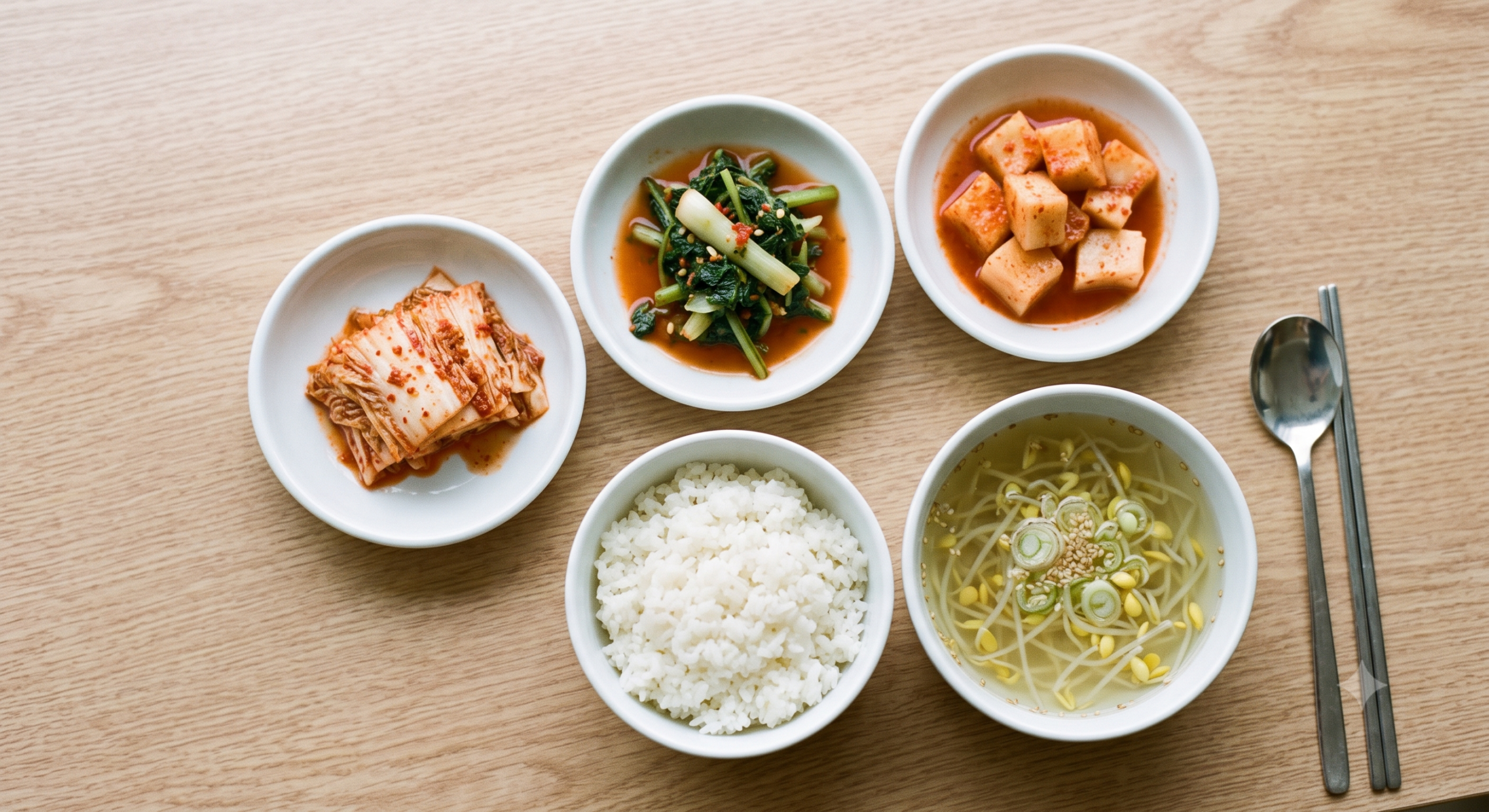
So, is kimchi a probiotic?
No — and the honest sentence is longer than that.
Kimchi is a fermented food that usually contains live and active cultures, which is a real and well-defined thing to be. It is not a probiotic, because that word now means a characterised strain at a known dose with a demonstrated effect, and a jar of kimchi offers none of those three in a form anyone can verify.
I had this muddled for years. I assumed fermented and probiotic were the same claim in two registers, and that a more sour jar simply meant more bacteria. The definition says otherwise, and so does the batch data.
What changes if you accept the narrower word? Very little at the dinner table, and quite a lot at the shop. If you want a specific strain because you read a specific study, a jar of kimchi cannot supply it, and no amount of eating more will. If you want a fermented vegetable you enjoy, kimchi does not need the label to be worth having. Those are different purchases, and the word “probiotic” is what tells them apart.
Key Terms
- Probiotic — live microorganisms that, in adequate amounts, confer a health benefit. All three parts are required.
- Strain — one specific registered isolate, like an individual rather than a family name. Effects are shown at this level.
- CFU — colony-forming unit, the way live bacteria are counted. 9 log CFU/g is a thousand times 6 log CFU/g.
- Fermented food — food made through desired microbial growth. It may or may not still contain live microbes.
- Live and active cultures — a label term meaning the microbes are present at levels expected for that food, with no health claim attached.
At a Glance
- The agreed definition requires three things at once: live microorganisms, an adequate amount, and a demonstrated health benefit[1].
- Kimchi meets the first, is variable on the second, and has not met the third as a food[2].
- Measured lactic acid bacteria counts in kimchi have ranged from about 6 to 9 log CFU/g across studies — a thousandfold spread[3].
- Korea’s notified probiotic standard specifies 100 million to 10 billion CFU a day from a fixed list of 19 species[4].
- The accurate label for most kimchi is “live and active cultures”, not “contains probiotics”[2].
- Packaged cabbage kimchi averaged 569.6 mg sodium per 100 g in a 2019 Korean retail test[5], against a chronic-disease-risk-reduction figure of 2,300 mg a day that falls with age[6].
※ This article explains how a term is defined and is for informational purposes only. It is not dietary advice and not a recommendation to eat or avoid any food. It does not replace medical advice, diagnosis or treatment — consult a clinician or a dietitian about your own diet.
References
- Hill C, Guarner F, Reid G, et al. — Expert consensus document: The International Scientific Association for Probiotics and Prebiotics consensus statement on the scope and appropriate use of the term probiotic. Nat Rev Gastroenterol Hepatol 2014;11(8):506-14. https://doi.org/10.1038/nrgastro.2014.66
- Marco ML, Sanders ME, Gänzle M, et al. — The International Scientific Association for Probiotics and Prebiotics (ISAPP) consensus statement on fermented foods. Nat Rev Gastroenterol Hepatol 2021;18(3):196-208. https://doi.org/10.1038/s41575-020-00390-5
- Maoloni A, Ferrocino I, Milanović V, et al. — The Microbial Diversity of Non-Korean Kimchi as Revealed by Viable Counting and Metataxonomic Sequencing. Foods 2020;9(11):1568. https://doi.org/10.3390/foods9111568
- Korean trade-press summary of the MFDS notified standard for probiotics as a health functional food ingredient (daily intake, recognised species). Social Times, 2023. https://www.esocialtimes.com/news/articleView.html?idxno=30719 · MFDS ingredient register: https://www.foodsafetykorea.go.kr/portal/board/board.do?menu_grp=MENU_NEW01&menu_no=2660
- Consumers Korea (소비자시민모임) 2019 test of 15 retail packaged cabbage kimchi products, sodium per 100 g, as reported by Foodicon. https://www.foodicon.co.kr/news/articleView.html?idxno=3817
- Ministry of Health and Welfare & The Korean Nutrition Society — 2025 Dietary Reference Intakes for Koreans (KDRIs), sodium summary table. https://www.kns.or.kr/fileroom/fileroom_view.asp?idx=167&BoardID=Kdr · summary PDF: https://health.seoulmc.or.kr/uploadFiles/2025_%ED%95%9C%EA%B5%AD%EC%9D%B8%EC%98%81%EC%96%91%EC%86%8C%EC%84%AD%EC%B7%A8%EA%B8%B0%EC%A4%80_%ED%99%9C%EC%9A%A9.pdf