If you have ever put a calcium bottle back on the shelf because of something you read about heart attacks, you are reacting to a real argument. It has been running since 2010, and it has not been settled by one side winning.
What makes it confusing is not that the evidence is thin. It is that two kinds of evidence keep pointing in different directions, and both kinds are published in good journals by careful people. Pooled randomised trials of calcium supplements have repeatedly found a small increase in cardiovascular events. A guideline panel that read the same file concluded there was no relationship at all.
This post walks the argument in order, year by year. Then it does something most English coverage skips. It asks what any of it means if your daily calcium intake looks like a typical Korean one rather than a typical American one, and that turns out to change the question.
2010 and 2011: two papers put calcium supplements on the cardiology agenda
The argument begins with a pooled analysis of trials that had been run for bone, not for the heart.
In 2010, a group at the University of Auckland pooled 15 randomised placebo-controlled trials of calcium supplements taken at 500 mg a day or more. Across the five trials with participant-level data — 8,151 people followed for a median of 3.6 years — 143 people on calcium had a heart attack against 111 on placebo, a hazard ratio of 1.31 (95% CI 1.02 to 1.67)[1]. The trial-level pooling gave a similar figure, a relative risk of 1.27[1].
A hazard ratio of 1.31 means the rate was about 31% higher in the calcium group. The confidence interval running from 1.02 to 1.67 means the true figure could plausibly be almost nothing or could be much larger — the result clears the “no difference” line, but not by much.
The following year the same group went back to the Women’s Health Initiative, the largest trial in the field, and re-analysed it. Their argument was that the WHI result had been blurred because so many participants were already taking their own calcium before randomisation. Separating out the 16,718 women who were not, they reported hazard ratios between 1.13 and 1.22 for cardiovascular events, and their updated pooling across eight trials gave a relative risk of 1.24 for heart attack[2].
That is where the headlines came from. Neither paper claimed a large effect. Both argued the effect was real and worth acting on.
2016: a guideline panel read the same file and landed elsewhere
Six years later, two professional bodies convened a panel, commissioned an independent evidence review, and reached the opposite conclusion.
The National Osteoporosis Foundation and the American Society for Preventive Cardiology adopted a clear position. There is moderate-quality (B-level) evidence that calcium, with or without vitamin D, from food or supplements has no relationship — beneficial or harmful — to cardiovascular or cerebrovascular disease, mortality, or all-cause mortality in generally healthy adults[3]. They added that intake up to the tolerable upper level, which the National Academy of Medicine sets at 2,000 to 2,500 mg a day, should be considered safe from a cardiovascular standpoint[3].
This is the part readers find hardest to accept: both groups were looking at substantially the same trials. They differed on which trials to include, how to handle the cardiovascular outcomes in studies that had not been designed to collect them, and how much weight to give observational data alongside the randomised data.
[Table 1] How the conclusion moved, 2010 to 2021 · Source: pooled trial analyses and guideline panel[1][2][3][4]
| Year | What was pooled | What it concluded |
| 2010 | 15 RCTs, calcium alone | MI hazard ratio 1.31; relative risk 1.27 |
| 2011 | WHI re-analysis + 8 trials | MI relative risk 1.24 |
| 2016 | Independent evidence review | No relationship, up to the upper intake level |
| 2021 | 13 double-blind placebo-controlled RCTs | CVD relative risk 1.15 |
Read the right-hand column as four separate readings of an overlapping body of work, not as a sequence in which each line corrects the one above it.
2021: a newer pooling put the signal back, and showed where it lives
A 2021 meta-analysis restricted itself to double-blind, placebo-controlled trials and found the increase again — in one specific group.
Researchers at Korea’s National Cancer Center pooled 13 double-blind placebo-controlled randomised trials, 28,935 people in the intervention arms and 14,243 in the control arms. Calcium supplements were associated with a relative risk of 1.15 for cardiovascular disease (95% CI 1.06 to 1.25) and 1.16 for coronary heart disease, specifically in healthy postmenopausal women[4].
Two features of that result matter. The heterogeneity statistic was zero, meaning the included trials agreed with each other unusually well. And the finding was anchored to a population — healthy postmenopausal women supplementing on top of a diet that already met recommendations. That is not the same population as a woman whose diet supplies 400 mg a day.
Relative risk 1.15 means about 15% more events in the supplemented group. On a low baseline risk, 15% more of a small number is still a small number — which is why the same figure can be described as “a real signal” and “not much” without either description being wrong.
What the adverse-event reports contain, and what no review can say
The reports people file about calcium supplements are mostly not about hearts. They are about swallowing, and the pattern is worth seeing.
The US Food and Drug Administration publishes its adverse-event database, CAERS, as an open API. Filtering it to supplement-category products whose brand name contains “calcium” returns 4,085 reports. The reaction terms that come up most often are mechanical and digestive[5].
[Table 2] Most frequent reaction terms in calcium supplement reports · Source: FDA CAERS, data current to 7 July 2026[5]
| Reaction term | Reports |
| Choking | 879 |
| Dysphagia (difficulty swallowing) | 322 |
| Dyspnoea (breathlessness) | 241 |
| Nausea | 165 |
| Diarrhoea | 162 |
Myocardial infarction appears in 25 of those 4,085 reports[5]. That is not evidence that calcium is safe for the heart, and it should not be read that way — a voluntary reporting system cannot measure how often something happens. But it does say something about the gap between what the debate is about and what people actually report: a tablet that is genuinely difficult to swallow.
One point of language matters here. These are adverse events, not confirmed side effects. A report records a symptom suspected of being linked to a product, and submitting one is not an admission that the product caused anything. Causality is not established, duplicate reports can occur, and many events are never reported at all. Many reports also record concomitant products and no attributed symptom for calcium itself, which is the ordinary texture of this database. FDA requires manufacturers to report serious events; reports from consumers and clinicians are voluntary, so the mix is shaped by who chooses to file.
What calcium supplements look like if you live in Korea
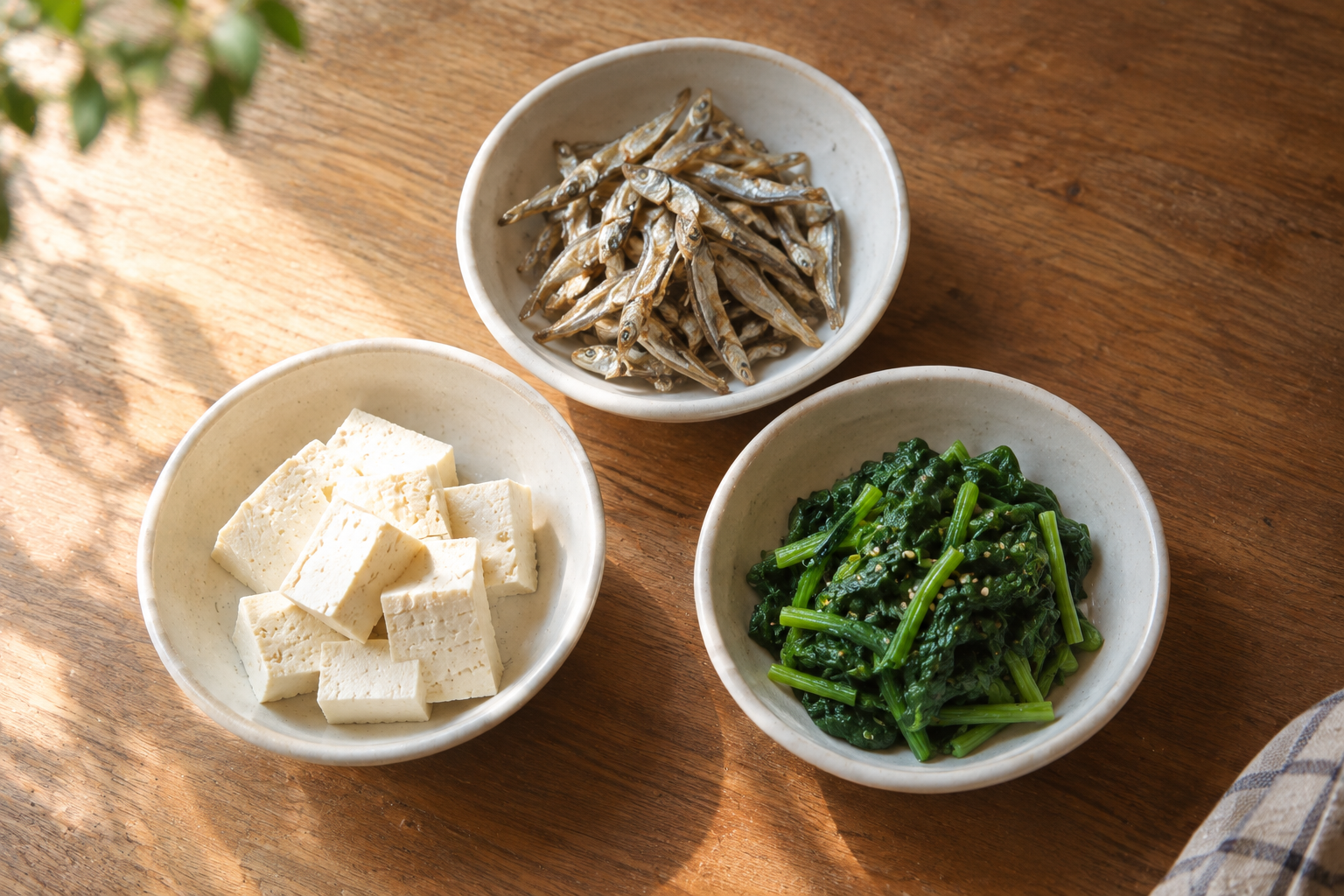
Here is the part that changes the question. The Western argument assumes you are adding supplements on top of a diet that already meets the recommendation. In Korea, that assumption usually fails.
The Korean Society for Bone and Mineral Research notes that Asian populations have low dietary calcium intake, with a mean of about 470 mg a day in people over 50 — far below comparable Western populations. Average intake across Korea and neighbouring countries sits around 300 to 500 mg a day[6]. In one Korean study, the group with osteoporosis averaged 440 mg a day against 596 mg in the normal group[6].
The society recommends a daily calcium intake of 800 to 1,000 mg, states that food remains the best source, and says supplements should be considered when dietary intake cannot reach that level[6]. On cardiovascular risk it is direct: the evidence that calcium supplementation is causally related to cardiovascular events “appears to be inconclusive”, and there is no clear evidence about which intake level might be harmful in Korea specifically[6].
Where the numbers sit
The intakes linked to harm are well above both the Korean average and the Korean target.
Note — these are population averages, not a personal target, and totals include food. Discuss your own number with a clinician.
Where the numbers sit →
The diagram shows the gap that matters. The intakes at which harm has been suggested sit well above both the Korean average and the Korean target. For most people reading this in Korea, the live question is whether they are reaching 800 mg, not whether they are exceeding 1,200.
That does not make the trial findings irrelevant. If you already eat a calcium-rich diet and take a 1,000 mg tablet on top, you are closer to the population those trials studied. If you are taking calcium on medical advice — after a fracture, for osteoporosis, alongside a bone medication — do not stop or change the dose on your own. Raise this with the doctor who prescribed it.
Key Terms
- Hazard ratio / relative risk — how many times more often an event happened in one group than the other. 1.15 means 15% more.
- Confidence interval — the range the true value could plausibly take. If it crosses 1.00, “no difference” is still possible.
- Double-blind, placebo-controlled — neither participants nor researchers knew who got the real supplement.
- Heterogeneity (I²) — how much the pooled studies disagreed. Zero means they agreed closely.
- CAERS — the FDA’s adverse-event reporting system for foods and supplements. Reports are not verified and cannot measure incidence.
At a Glance
- Pooled randomised trials in 2010 and 2011 found roughly a 24–31% higher rate of heart attack with calcium supplements[1][2].
- A 2016 guideline panel reviewing the same field found no relationship, and called intake up to 2,000–2,500 mg a day cardiovascularly safe[3].
- A 2021 pooling of 13 blinded trials found a 15% higher cardiovascular risk, specifically in healthy postmenopausal women[4].
- In FDA adverse-event reports, choking and difficulty swallowing dominate; myocardial infarction appears in 25 of 4,085 reports[5].
- Korean dietary calcium averages roughly 300–500 mg a day against a recommended 800–1,000 mg; food first, supplements to close the gap[6].
- The intakes where harm has been suggested, 1,200 mg and above, sit well beyond where most people in Korea actually are[6].
The question worth asking instead
The honest summary is that the effect of calcium supplements, if it exists, is small, contested, and anchored to people who were already getting enough calcium from food. That is a very different sentence from “calcium supplements cause heart attacks”, and it is the one the evidence supports.
What changed my own reading was the Korean intake figure. I had been treating this as a question about whether to take the supplement at all. It is better treated as a question about where your total lands — diet plus tablet — and most people in Korea land low rather than high.
So the useful move is not to put the calcium supplements back on the shelf. It is to add up what you already eat, see how far short you are, and take that number to the person who knows your bone density and your heart.
Next in this series: how calcium salts differ in elemental content, and why the number on the front of the bottle is rarely the number that matters.
※ This article is for information only and does not replace diagnosis or prescription. If you take medication or have an existing condition, consult a doctor or pharmacist before starting or changing any supplement.
References
- Bolland MJ, Avenell A, Baron JA, et al., “Effect of calcium supplements on risk of myocardial infarction and cardiovascular events: meta-analysis”, BMJ 2010;341:c3691 (indexed in PubMed), https://doi.org/10.1136/bmj.c3691
- Bolland MJ, Grey A, Avenell A, Gamble GD, Reid IR, “Calcium supplements with or without vitamin D and risk of cardiovascular events: reanalysis of the Women’s Health Initiative limited access dataset and meta-analysis”, BMJ 2011;342:d2040 (indexed in PubMed), https://doi.org/10.1136/bmj.d2040
- Kopecky SL, Bauer DC, Gulati M, et al., “Lack of Evidence Linking Calcium With or Without Vitamin D Supplementation to Cardiovascular Disease in Generally Healthy Adults: A Clinical Guideline From the National Osteoporosis Foundation and the American Society for Preventive Cardiology”, Annals of Internal Medicine 2016;165(12):867-868 (indexed in PubMed), https://doi.org/10.7326/M16-1743
- Myung SK, Kim HB, Lee YJ, Choi YJ, Oh SW, “Calcium Supplements and Risk of Cardiovascular Disease: A Meta-Analysis of Clinical Trials”, Nutrients 2021;13(2):368 (indexed in PubMed), https://doi.org/10.3390/nu13020368
- S. Food and Drug Administration, CAERS (CFSAN Adverse Event Reporting System) open API, food/event endpoint, queried 5 October 2026, https://open.fda.gov/apis/food/event/
- Korean Society for Bone and Mineral Research, “Calcium and Vitamin D Supplementations: 2015 Position Statement of the Korean Society for Bone and Mineral Research”, Journal of Bone Metabolism 2015;22(4):143-149 (indexed in PubMed), https://doi.org/10.11005/jbm.2015.22.4.143