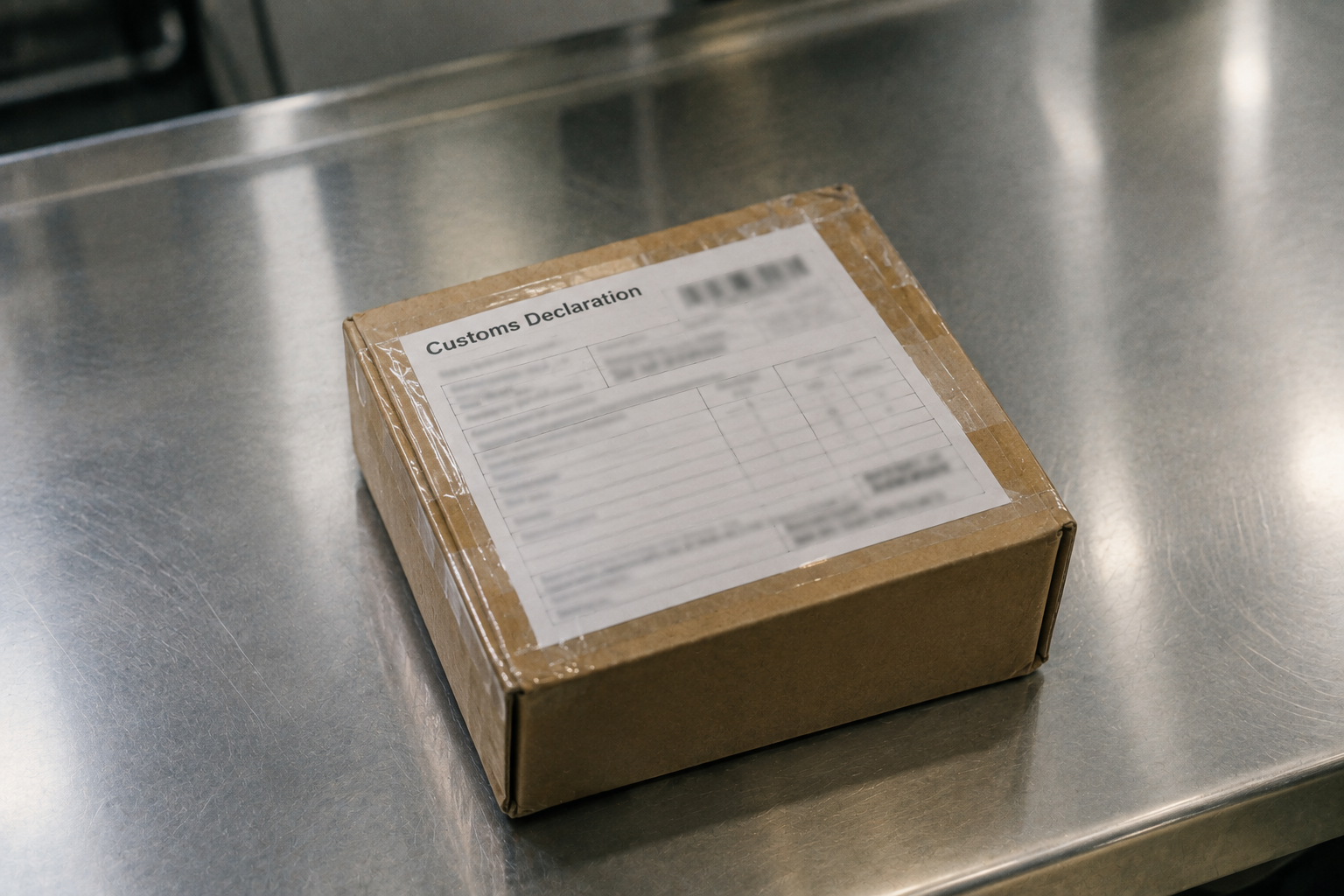
Bringing Supplements Into Korea: Customs Rules and Limits
If you moved to Korea and kept ordering the supplements you were used to, you have probably already met the system the hard way. A parcel sat somewhere for two weeks. A form asked for a resident registration number. Something arrived and something else did not.
None of that is arbitrary. Supplements sit in a specific lane in Korean import rules, and the lane has a handful of numbers attached to it. Once you know the numbers, most of the surprises stop.
What follows are the questions people actually arrive with, answered from the Korea Customs Service and the Ministry of Food and Drug Safety. One caveat before any of it: these rules are applied case by case, they change, and the account below is a starting point for asking rather than a ruling on your particular parcel.
Can I just order supplements, or does customs treat them differently?
Differently, and this is the fact that trips up most newcomers.
Korea has a simplified clearance lane called 목록통관, list clearance, which applies to personal-use goods valued at US$150 or less — US$200 or less for goods shipped from the United States. Parcels in that lane move through on a list rather than a full declaration[1].
Health functional foods are excluded from it. So are pharmaceuticals, medical devices, quarantine items, food products and functional cosmetics. The customs guide names the excluded categories explicitly, and 건강기능식품 — listing vitamins, omega-3 and glucosamine products as examples — is one of them. Excluded goods must go through 일반수입신고, a standard import declaration[1].
Two things follow. Your supplement parcel needs a formal declaration whatever it cost, which is why the courier asks you for identification details that a book order never triggers. And the US$150 figure still matters, but for tax rather than for procedure: above it, duty applies, and the dutiable value includes shipping and insurance to Korea[1].
How many bottles can I actually order or bring?
Six.
The Korea Customs Service publishes a 자가사용 인정기준, a personal-use recognition standard, which sets quantities that customs will accept as plausibly for your own use. For health functional foods the figure is a total of six bottles[2].
Within that, and within the duty-free value range, the requirement check is waived — 면세통관범위인 경우 요건확인 면제[2]. Go above six bottles and the requirement check applies rather than the parcel simply vanishing. There is also a documented exception: someone importing health functional foods in connection with treating an illness may be granted exemption on the basis of a physician’s opinion, within reasonable limits[2].
[Table 1] The figures that govern a supplement parcel · Source: Korea Customs Service[1][2]
| What | Figure | What it decides |
| List clearance threshold | US$150 (US$200 from the US) | Duty, not procedure — supplements are excluded from the lane |
| Personal-use quantity | 6 bottles total | Whether a requirement check is waived |
| Above 6 bottles | Requirement check applies | Not automatic disposal |
Read the third row carefully, because the common fear — that a seventh bottle means everything is destroyed — is not what the standard says. It says a check applies.
What gets stopped regardless of how few I have?
Quantity is only one of the two gates, and the second one ignores it entirely.
The same customs standard lists categories that require verification no matter how small the shipment. Goods regulated under CITES. Products containing ingredients that MFDS has identified as banned or harmful. Products whose ingredient labelling is unclear. Products containing ephedrine or related substances[2].
That second category is the one worth knowing about, because MFDS maintains a searchable list of specific overseas products it has asked customs to block. At the time of writing the list page displayed on the order of 5,000 entries. The detected substances running through it are largely undeclared pharmaceuticals — sibutramine, an appetite suppressant withdrawn over cardiovascular risk, appears repeatedly[4].
MFDS describes the risk concentration plainly: the focus is on overseas direct-purchase foods marketed for weight loss, sexual function and muscle building — Diet, Sexual Function Enhancement, Muscle Strengthening[3].
[Table 2] The two gates a supplement parcel passes through · Source: Korea Customs Service[2]; MFDS[3][4]
| Gate | Trigger | Applies at any quantity? |
| Quantity | More than 6 bottles | No — quantity-based |
| Composition | Banned ingredient, unclear labelling, ephedrine, CITES | Yes |
Is there anything that is simply not allowed?
Yes, and the example that catches the most people is melatonin.
In most countries melatonin sits on a shelf next to the magnesium. In Korea it is licensed as a prescription medicine. An official ministry interpretation published on the national law information portal answers the direct question — whether a food containing plant-derived melatonin can be brought in by overseas direct purchase — and the answer is no. According to the interpretation, imports will be blocked regardless of melatonin content (dosage), origin (natural or synthetic), or the characteristics of its products (gel, tablet, etc.). That is: regardless of dose, regardless of whether it is natural or synthetic, and regardless of the product form. The basis given is the Special Act on Imported Food Safety Control and its enforcement rules, together with melatonin’s status as a prescription drug domestically with no established safety data as a food ingredient[5].
“Plant-derived” and “it’s only 3 mg” and “it’s a gummy, not a pill” are all specifically covered by that sentence.
This is also where individual circumstances matter most. If something you take was prescribed to you abroad, the route into Korea is a conversation with a Korean doctor or pharmacist about the domestic equivalent, not a workaround at the border. What is a supplement in one country is a controlled medicine in another, and the classification travels with the country, not with you.
What do the blocked lists and consumer reviews actually show?
Government data rather than comment threads, as usual on this blog — and here the data is unusually well matched to the question.
Use of the MFDS overseas direct-purchase food portal has climbed steeply: roughly 300,000 users in 2023, 400,000 in 2024 and 890,000 in 2025, according to a government policy briefing published on 6 February 2026[6]. People are looking things up, in growing numbers, which is itself a signal about how often the answer turns out to be unwelcome.
The satisfying part of this story, for the buyer, is that the check is free and takes a minute. The dissatisfying part is what people find: the briefing describes a writer discovering that an immune vitamin product they had been buying was on the hazardous list[6]. That is the characteristic experience in this group — not a dramatic seizure, but a quiet discovery that a routine repeat purchase was never eligible.
I should be careful not to flatten this into a group verdict. Outcomes vary a great deal by what you order, where it ships from, how it is declared and which office handles it. Two people ordering the same product in the same month can have different experiences, and nothing here predicts yours.
What should I check before I click buy?
Four things, in about two minutes.
Four checks before ordering supplements to Korea
The first two decide whether it can come in. The last two decide what it costs.
Note — rules change and are applied case by case. Confirm the current position with the Korea Customs Service and MFDS before ordering.
Before ordering supplements to Korea →
The first two are about whether it can come in at all. The last two are about how much friction and cost it carries if it can.
I had assumed for a long time that the US$150 figure was the whole story, and that supplements cleared like any small parcel. They do not — they are outside the simplified lane entirely, which explains the paperwork that always seemed disproportionate to a bottle of fish oil.
One closing note, and it is the one that matters most. Everything above is the published framework, not a prediction. Rules are revised, lists grow, and officers exercise judgement on the facts in front of them. For anything you actually care about, check the current MFDS portal and the Korea Customs Service pages before ordering. And for anything medical — a prescribed product, a chronic condition, a supplement you were told to keep taking — ask a Korean pharmacist or doctor rather than working it out from a blog.
Key Terms
- 목록통관 (list clearance) — a simplified customs lane for low-value personal goods. Supplements are excluded from it.
- 일반수입신고 (standard import declaration) — the full declaration route that supplement parcels must use whatever their value.
- 자가사용 인정기준 (personal-use recognition standard) — published quantities customs accepts as plausibly for your own use. Six bottles for health functional foods.
- 요건확인 (requirement check) — verification that an item meets the conditions for import. Waived within the personal-use and duty-free range.
- 건강기능식품 (health functional food) — Korea’s regulated supplement category, and the words to look for on a domestic package.
At a Glance
- Supplements are excluded from Korea’s simplified list-clearance lane and need a standard import declaration whatever their value[1].
- The US$150 threshold (US$200 from the United States) governs duty, not procedure, and the dutiable value includes shipping and insurance[1].
- The personal-use recognition standard for health functional foods is a total of six bottles[2].
- Within six bottles and the duty-free range the requirement check is waived; above it, a check applies rather than automatic disposal[2].
- Some products are checked at any quantity: banned or harmful ingredients, unclear labelling, ephedrine-containing products and CITES goods[2].
- Melatonin is a prescription medicine in Korea and is blocked from entry regardless of dose, natural or synthetic origin, or product form[5].
- MFDS runs a searchable blocked-product list dominated by undeclared pharmaceuticals such as sibutramine, concentrated in weight-loss, sexual-function and muscle-building products[3][4].
- Use of the MFDS overseas direct-purchase portal rose from about 300,000 users in 2023 to 890,000 in 2025[6].
※ This article summarises published Korean customs and food safety rules as at the date of writing and is for general information only. It is not legal, customs or medical advice. Rules change and are applied case by case. Confirm current requirements with the Korea Customs Service and the Ministry of Food and Drug Safety before ordering. Consult a Korean pharmacist or doctor about any prescribed or medically necessary product rather than acting on this article.
References
- Korea Customs Service — 알아두면 유익한 해외 직구 통관 길라잡이 (overseas direct purchase clearance guide): list clearance thresholds and excluded categories. https://unipass.customs.go.kr/csp/template/persecmiss/directFaq_2020.pdf
- Korea Customs Service, Incheon Airport Customs — 자가사용 인정기준 (personal-use recognition standard), health functional foods row and requirement-check notes. https://www.customs.go.kr/incheon_airport/cm/cntnts/cntntsView.do?mi=12713&cntntsId=6719
- Ministry of Food and Drug Safety — 해외직구식품 올바로 portal, risk categories for overseas direct-purchase foods. https://www.foodsafetykorea.go.kr/portal/fooddanger/foodDirectImportView.do
- Ministry of Food and Drug Safety — 해외직구 위해식품 차단 목록 (blocked overseas direct-purchase food list), searchable database. https://www.foodsafetykorea.go.kr/portal/fooddanger/foodDirectImportBlock.do?menu_grp=MENU_NEW02&menu_no=3594 · https://impfood.mfds.go.kr/CFCBB02F01
- Korea Law Information Center — central ministry interpretation on whether food containing plant-derived melatonin may be imported by overseas direct purchase (2024). https://www.law.go.kr/LSW/cgmExpcInfoP.do?cgmExpcDatSeq=419334&mode=2&ofiClsCd=350123
- Korean Government Policy Briefing (대한민국 정책브리핑) — 해외직구식품 안전 정보 ‘해외직구식품 올바로’에서 확인, portal usage figures, published 6 February 2026. https://www.korea.kr/news/reporterView.do?newsId=148958966