Korea’s national health screening is available to foreign residents on the same terms as Korean nationals, provided you’re enrolled in the National Health Insurance Service. Plenty of people who qualify never use it. The notification arrives in Korean, gets set aside, and the year passes.
That’s worth fixing, and not only for the obvious reason. The standard panel happens to include most of the blood values this blog spends its time on: hemoglobin, fasting glucose, liver enzymes, kidney function, and — for women from 40 — a full lipid panel. If you have ever wondered whether a supplement decision makes sense for you specifically, some of the relevant numbers are sitting in a free test you may already be entitled to.
Who is eligible
Enrolment in the National Health Insurance Service is the gateway. Foreign residents who are enrolled receive the same national screening entitlement as Korean nationals[2].
The general health screening (일반건강검진) runs on a two-year cycle, and which year is yours depends on your birth year. People born in even-numbered years are screened in even-numbered years; odd in odd. 2026 is an even year, so if your birth year ends in an even digit, this is your year[3].
One exception worth knowing: employees in non-office roles are screened annually rather than biennially, regardless of birth year[3].
If you were eligible last year and didn’t go, it’s worth checking whether you can still be screened — carry-over is sometimes possible.
How to check and book
Three routes, in rough order of convenience:
- The NHIS website — log in and look for the health screening section to see your status for the year[2]
- The 건강보험 mobile app
- The NHIS call centre, 1577-1000
Eligible people are sent a notice by post to their registered address. If you’ve moved and not updated your address, that’s a common reason the notification never arrives.
Bring your Alien Registration Card. The postal notice helps if you have it, but identification is the essential item.
One piece of timing advice: October through December is heavily congested, with December running several times the normal volume. Booking earlier in the year means far more choice of date and location.
What the standard panel covers
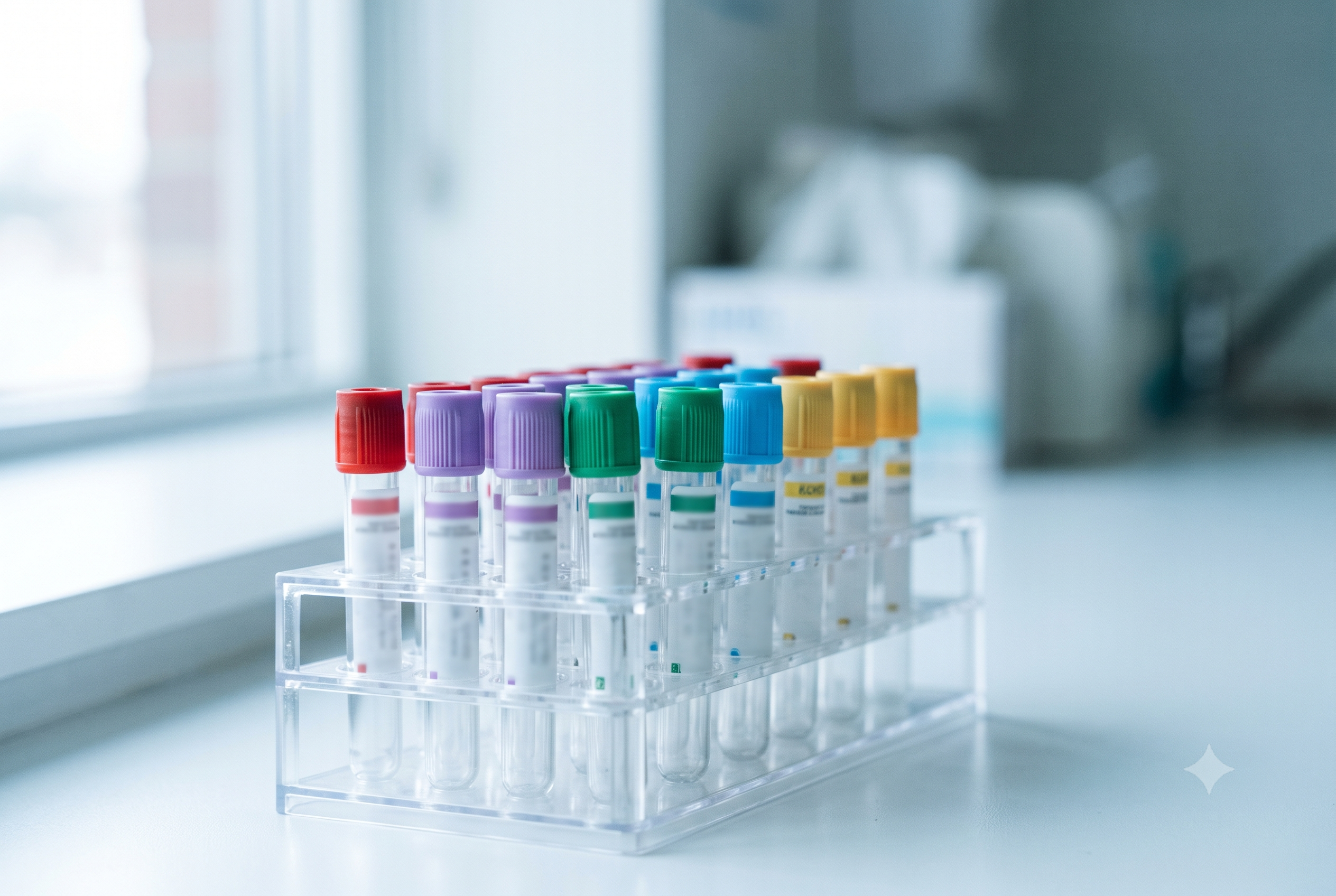
The base examination is fully covered by the insurer[1]. It includes a physical assessment — height, weight, BMI, waist circumference, blood pressure, vision and hearing — plus a chest X-ray, a urine protein test, and a blood draw[3].
The blood work is where it gets interesting for readers of this blog.
| Korean | Test | Relevant to |
| 공복혈당 | Fasting glucose | Blood sugar and insulin questions |
| 혈색소 | Hemoglobin | Anemia and iron supplementation |
| AST · ALT · 감마지티피 | Liver enzymes | Liver-related supplements, alcohol |
| 혈청크레아티닌 | Serum creatinine | Kidney function — relevant to protein and creatine cautions |
| 요단백 | Urine protein | Kidney function |
[Table 1] Blood values in the standard panel and where they come up here · Source: National Health Insurance Service General Health Screening Items[1][3]
That is a meaningful amount of information for something that costs nothing.
Additional tests by age and sex
Beyond the base panel, further tests are added at particular ages[3].
For women, the ones that matter most in this blog’s age range:
- Lipid panel (이상지질혈증) — total cholesterol, HDL, LDL and triglycerides. For women, from age 40, every four years[3]
- Hepatitis B — at age 40, for those not already known to be carriers or immune[3]
- Bone density (골다공증) — for women at specific ages in their fifties and sixties. The eligible ages have been expanded in recent years, so check the current list rather than an older guide
- Mental health screening — in the years you turn 20, 30, 40, 50, 60 and 70
- Lifestyle assessment — at 40, 50, 60 and 70
- Cognitive function screening — from 66, on a two-year cycle
The four-year lipid cycle is easy to miss. If you’re a woman over 40 and have never seen a cholesterol result from a Korean screening, it may simply not have been your year.
Cancer screening
Six cancers are covered under the national programme: stomach, liver, colorectal, lung, breast and cervical. Eligibility and intervals vary by cancer and age.
Cost-sharing differs too. Colorectal and cervical screening are fully covered. Stomach, breast, liver and lung screening carry a 10% co-payment, waived for those in the lower half of the insurance premium bracket and for medical benefit recipients.
Preparing for the appointment
Fasting is the part people get wrong.
No food from the evening before — and that includes water, coffee, milk, juice, gum and cigarettes on the morning of[1]. Morning appointments are preferable. If you must go in the afternoon, maintain at least eight hours of fasting beforehand, since a non-fasting sample produces different results[1].
Mention any medication you take. It’s relevant to how several of these values are read.
What the results are, and are not
Here is where I’d add a caution, because the free-test framing can be misleading in a particular way.
A screening panel is built to flag things worth investigating across a whole population. It is not a personalised assessment, and it wasn’t designed to answer “should I take this supplement.”
Three reasons it can’t. Reference ranges are population-based, not tailored to you. A single measurement is one moment, not a trend. And individual circumstances differ enough that two people with identical numbers can warrant quite different advice.
If something falls outside range, follow-up consultation is available under the programme for suspected hypertension, diabetes, dyslipidemia and several other findings[1]. That consultation, not the printout, is where interpretation belongs.
What the results are genuinely good for is making a conversation more specific. Arriving at a pharmacy or clinic with actual values, rather than a general sense that something feels off, changes what you can usefully ask.
Practical notes for foreign residents
A few things that come up repeatedly:
- Keep the printed result. If you later see a doctor in another country, the values transfer even when the language doesn’t. Photograph the whole page — units and reference ranges are in the surrounding text.
- Language support varies by facility. Larger hospitals and international clinics are more likely to have English-speaking staff; smaller neighbourhood clinics may not.
- Update your registered address with the NHIS after moving, or the notice goes to the old one.
- Screening year is by birth year, not by how long you’ve been in Korea. Newly arrived residents are sometimes surprised to find they’re eligible immediately.
Closing
The screening programme is one of the more straightforward things to access as a foreign resident here, and it produces exactly the kind of baseline that makes supplement decisions less speculative.
I’d been treating “check with a doctor” as advice that required a specific complaint to act on. It doesn’t. A scheduled screening you’re already entitled to produces the numbers, and the follow-up consultation is built into the programme. That’s a lower bar than it first appears.
Details change — eligible ages for individual tests have been revised more than once in recent years. Confirm the current position with the NHIS rather than relying on any article, including this one.
Next in this series: reading the Korean terms on a lab report, and which values map onto the questions this blog covers.
At a Glance
- Foreign residents enrolled in the NHIS have the same national screening entitlement as Korean nationals
- General screening runs biennially by birth year parity — 2026 is an even year; non-office employees are screened annually
- Check eligibility via the NHIS website, the mobile app, or 1577-1000; bring your Alien Registration Card
- The base panel includes fasting glucose, hemoglobin, liver enzymes and serum creatinine — fully covered
- Women from 40 receive a lipid panel every four years; bone density screening applies at specific ages
- Fasting means no food or drink, including water, on the morning of the test
- Population reference ranges are not personalised advice — interpretation belongs in the follow-up consultation
※ This article is for general information about an administrative programme and does not replace medical advice, diagnosis or treatment. Eligibility rules, covered tests and age criteria are revised periodically — confirm current details with the National Health Insurance Service. Do not interpret screening values on your own or start, stop or adjust any supplement or medication on the basis of them; please consult a clinician.
References
- 국민건강보험공단, 「일반건강검진 — 건강검진 실시안내」, https://www.nhis.or.kr/nhis/healthin/wbhaca04500m01.do
- 국민건강보험공단 홈페이지 (자격 및 대상자 조회), https://www.nhis.or.kr/nhis/index.do
- 을지대학교병원 건강증진센터, 「일반건강검진 검사 항목 안내」, https://health.emc.ac.kr/national/national_pg03_01.jsp