Red Yeast Rice with Statins: Four Things People Believe, and What the Assessments Say
Someone on a cholesterol prescription sees red yeast rice on a shelf — in a pharmacy here, in a health shop back home, in an online basket — and the reasoning assembles itself in a second. It is a food. It is traditional. It is sold without a prescription. So at worst it does nothing, and at best it helps.
Each step in that chain has been examined by a regulator or a pharmacovigilance team, and each one comes apart in a different place. The order matters, because the last one is where the muscle reports are.
This post takes the four beliefs in turn, then looks at what the adverse-event record can and cannot say.
“Red yeast rice is natural, so it’s gentler than a statin”
This is the belief that has to go first, because the rest depend on it.
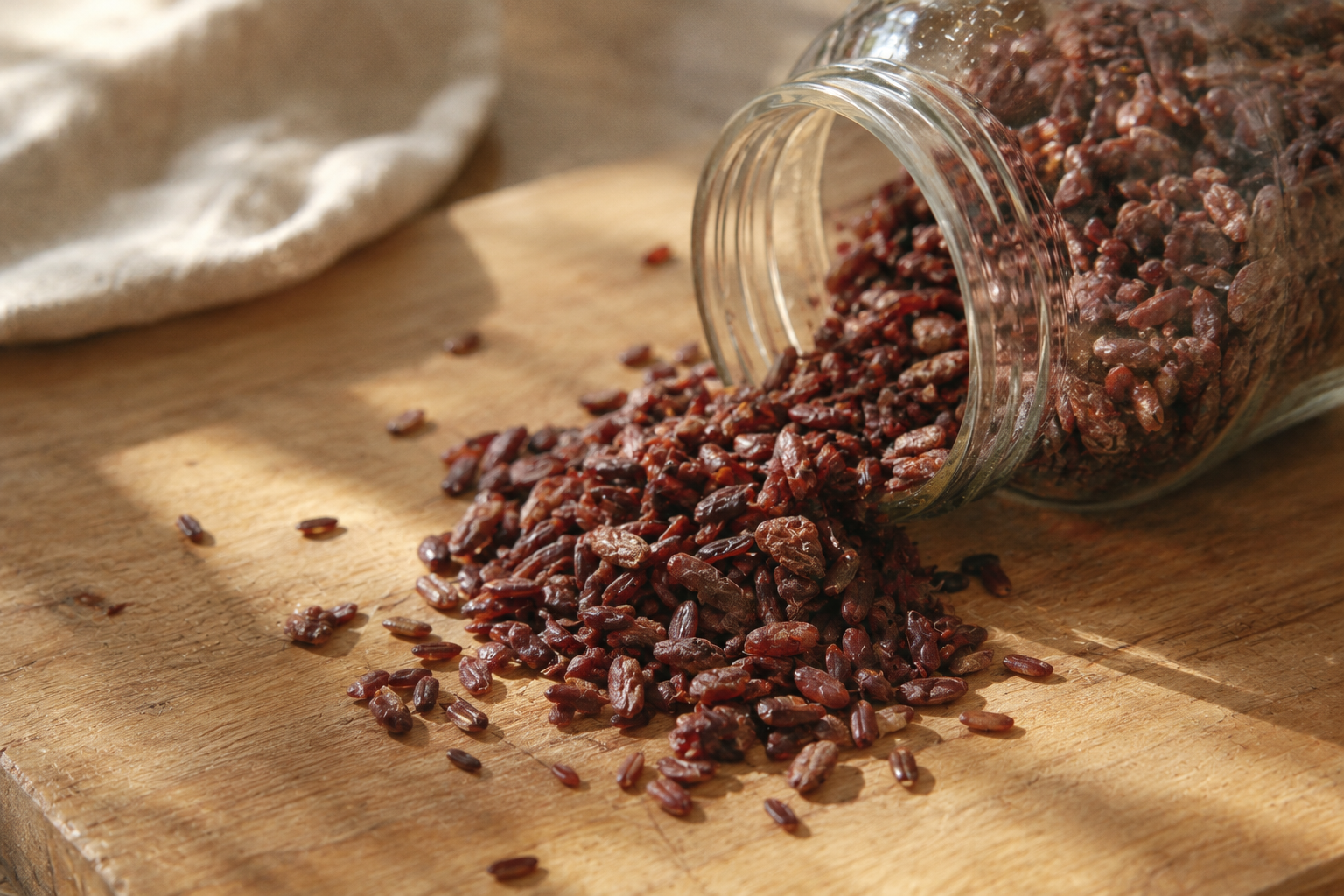
Red yeast rice is rice fermented with the mould *Monascus purpureus*. During fermentation the mould produces a family of compounds called monacolins, and the main one is monacolin K. According to PubMed, the European Food Safety Authority examined this directly and concluded that monacolin K in lactone form is identical to lovastatin, the active ingredient of medicines authorised in the EU for high cholesterol[1].
Identical is not a loose word there. It is the same molecule, acting on the same enzyme — HMG-CoA reductase, the step your liver uses to make cholesterol. A statin blocks that enzyme. Monacolin K blocks that enzyme. The difference between them is not chemistry; it is which aisle they are sold in.
EFSA also estimated that intake of monacolins from supplements could reach the range of therapeutic doses of lovastatin[1]. So the gentler-than-a-statin reading inverts: the question is not whether this is as strong as a medicine, but whether you can tell how strong your particular bottle is.
One enzyme, two labels
Why a red yeast rice supplement is not a gentler version of a statin.
Note — this is not a reason to start or stop anything by yourself. Bring the bottle to the doctor or pharmacist who manages your lipids.
What the enzyme sees →
The arrows point at the same target from both sides, and that is the whole interaction in one line.
“It’s a food, so my prescription isn’t affected”
Here the belief stops being about chemistry and becomes about how many people are in this situation.
A lot of them. The Korean Society of Lipid and Atherosclerosis publishes a Dyslipidemia Fact Sheet, and the 2024 edition puts the crude prevalence of dyslipidemia at 40.9% in Korean adults for 2016–2022[3]. Age-adjusted hypercholesterolaemia rose from 8.8% to 22.4% between 2007 and 2022, and among people aware they have it, the treatment rate is 61.2%[3].
Read that next to a shelf of cholesterol supplements and the overlap is obvious. A large share of the people reaching for red yeast rice are not untreated people looking for a first option. They are people already on a prescription, adding something they have classified as food.
The classification is a regulatory one, not a pharmacological one. Your liver does not consult the label. If you take a prescribed lipid-lowering medicine, a red yeast rice product belongs on the list you bring to your doctor or pharmacist, exactly as a new prescription would. Have that conversation before buying, and change nothing on your own.
“I came off my statin because of muscle aches, so this is the safe swap”
Of the four beliefs, this one carries the most risk, and it is the most common reason people buy the product.
A 2018 pharmacovigilance study in *Drug Safety* opens on exactly this point. Red yeast rice supplements, the authors write, are proposed as an alternative in statin-intolerant patients, although they actually contain natural statin(s), and their safety in practice remains incompletely characterised[2].
The logic of the swap assumes the muscle symptoms came from statins as a drug class rather than from inhibiting that enzyme. If the symptoms tracked the mechanism, then swapping a prescribed statin for an unmeasured one changes the label on the bottle and nothing else that matters.
EFSA’s safety conclusions sit directly on top of this. The panel judged monacolins from red yeast rice to be of significant safety concern at a use level of 10 mg per day. It noted individual cases of severe adverse reactions at intakes as low as 3 mg per day, and concluded that exposure to monacolin K could lead to severe effects on the musculoskeletal system, including rhabdomyolysis, and on the liver[1]. It could not identify any intake that does not raise concerns about harmful effects[1].
So a history of muscle symptoms on a prescribed statin is a reason to raise red yeast rice with the clinician who manages your lipids — not a reason to treat it as the gentle version. Statin intolerance also has a workup of its own, with options inside the prescription that no shelf can offer.
“The number on the box tells me my dose”
Sometimes it does. The harder question is what the number is allowed to be.
[Table 1] Monacolin K per daily portion: what different rules allow · Sources: EFSA 2018[1], EU Regulation 2022/860[4], EFSA 2025[5], MFDS[6]
| Rule or reference point | Monacolin K per day |
| EU food supplement limit since 2022 | less than 3 mg[4] |
| Lowest intake with reported severe adverse reactions | 3 mg[1] |
| EFSA, 2025: safety below 3 mg | could not be established[5] |
| Korea, MFDS-approved intake for red yeast rice | 4–8 mg total monacolin K[6] |
The bottom row is the one worth sitting with. Korea’s approved daily intake range for red yeast rice as a health functional food ingredient is 4 to 8 milligrams of total monacolin K, with the permitted claim being help in improving blood cholesterol[6]. The EU’s cap is under 3 mg. Korea’s range begins above it.
That is not a verdict on either regulator. The two systems were answering different questions, and the Korean figure is an efficacy-based intake for a standalone functional food, not a judgement about combining it with a prescription. But a person moving between the two markets, comparing two bottles, is comparing numbers set by different reasoning — and a European-market bottle under 3 mg is not a smaller version of the same thing.
Two cautions on my own sourcing. The Korean 4–8 mg range comes from the MFDS published list of approved functional ingredients[6]. I could not verify from the primary notification text whether that range has been amended since, so treat it as the published figure rather than today’s confirmed one. Separately, EFSA’s 2025 opinion reviewed the new data submitted during the EU scrutiny period and reiterated the 2018 concerns, finding that safety below 3 mg per day still could not be established[5].
“Plenty of people take it with no problems” — what the reports and reviews actually show
Both halves of this are true, and the record can only speak to one of them.
The pharmacovigilance study above compared two FDA systems. It extracted 1,300 adverse events from FAERS, the drug-based archive, where red yeast rice appeared mainly as a concomitant agent. It found 159 in CAERS, the food and supplement system, where the product was recorded mainly as the suspect agent. Disproportionality analysis showed higher-than-expected reporting of serious muscular and hepatic injury. In CAERS there were 27 cases of rhabdomyolysis or myopathy, reporting odds ratio 8.44 (95% CI 5.44–13.10); in FAERS, five hepatic cases at 13.71 (5.44–34.57)[2].
The open CAERS database has since grown. Filtering it to products whose brand name contains “red yeast rice” returns 229 reports, current to 7 July 2026[7].
[Table 2] Most frequent reaction terms in red yeast rice reports · Source: FDA CAERS, data current to 7 July 2026[7]
| Reaction term | Reports |
| Myalgia (muscle pain) | 27 |
| Fatigue | 26 |
| Malaise | 25 |
| Muscle spasms | 25 |
| Liver function test abnormal | 20 |
Muscle and liver sit at the top of that list, which is what the mechanism would predict.
Now the language, because it matters more here than usual. These are adverse events, not confirmed side effects. Each report records a symptom suspected of being linked to a product; causality is not established, duplicates occur, and most events are never reported at all.
And this is the half the record cannot cover. An adverse-event system only receives reports from people who had a problem. There is no denominator — nothing in CAERS tells you how many people took red yeast rice and noticed nothing, which is almost certainly most of them. No approved source I could find publishes a no-symptom rate for this ingredient, so anyone quoting a percentage of users who tolerate it well is quoting something the data does not contain. A reporting odds ratio describes the shape of the reports, not your personal odds.
What the pattern does support is narrow and useful: when something goes wrong with a red yeast rice product, it goes wrong in the muscles and the liver more often than chance would suggest. The study’s own recommendation was that clinicians monitor these products for muscular and hepatic safety[2]. That is a reason to tell your doctor you are taking it, so that unexplained muscle pain is read with that information rather than without it.
Key Terms
- Monacolin K — the main statin-like compound in red yeast rice. In lactone form it is the same molecule as lovastatin.
- HMG-CoA reductase — the liver enzyme that both statins and monacolin K block.
- Rhabdomyolysis — severe muscle breakdown. The most serious muscle-related event in these reports.
- Reporting odds ratio — how over-represented a symptom is in a report database. It is not a risk to you.
- CAERS — the FDA’s food and supplement adverse-event system. Reports are unverified and have no denominator.
- Dyslipidemia — abnormal blood lipid levels, the umbrella term that includes high cholesterol.
At a Glance
- EFSA concluded that monacolin K in lactone form is identical to lovastatin and acts on the same enzyme as a prescribed statin[1].
- Supplement intakes could reach the range of therapeutic lovastatin doses, and no safe intake could be identified[1].
- Severe adverse reactions have been reported at monacolin K intakes as low as 3 mg per day[1]; the EU limit since 2022 is under 3 mg[4].
- Korea’s approved intake for red yeast rice is 4–8 mg total monacolin K, above the EU cap[6] — published figure, not independently re-verified.
- CAERS held 27 cases of rhabdomyolysis or myopathy with a reporting odds ratio of 8.44, and muscle and liver terms still lead the 229 current reports[2][7].
- Adverse-event systems have no denominator, so they cannot tell you how many users had no symptoms at all[7].
What I’d put on the table at the next appointment
What changed my own reading was noticing that all four beliefs rest on the same move: treating the regulatory category as if it described the pharmacology. Food aisle, so food. The enzyme does not know that.
Which makes the practical step unglamorous and small. If red yeast rice is in the house and a lipid prescription is too, bring the actual bottle — or a photograph of its panel, with the monacolin figure visible — to the doctor or pharmacist who manages your lipids. Let them tell you what the combination means for you. That is also the right conversation for anyone with liver concerns, anyone on medicines that interact with statins, and anyone who stopped a statin over muscle symptoms.
What I would not do is work it out alone in either direction. Neither starting it quietly nor stopping anything quietly is a decision this article can make, and the people with your bloods in front of them have information no general piece of writing has.
Next in this series: how to read the ingredient panel on a cholesterol supplement, and which numbers on it are standardised.
※ This article is for information only and does not replace diagnosis or prescription. If you take any prescribed medicine — a statin above all — or have a liver or kidney condition, consult your doctor or pharmacist before starting, combining or stopping a supplement. Do not adjust a prescribed medication on your own.
References
- EFSA ANS Panel, “Scientific opinion on the safety of monacolins in red yeast rice”, EFSA Journal 2018;16(8):e05368 (indexed in PubMed), https://doi.org/10.2903/j.efsa.2018.5368
- Raschi E, Girardi A, Poluzzi E, Forcesi E, Menniti-Ippolito F, Mazzanti G, De Ponti F, “Adverse Events to Food Supplements Containing Red Yeast Rice: Comparative Analysis of FAERS and CAERS Reporting Systems”, Drug Safety 2018;41(8):745-752 (indexed in PubMed), https://doi.org/10.1007/s40264-018-0661-3
- Kwon O, Lee SY, Kim B, Han K, Ahn J, “Dyslipidemia Fact Sheet in South Korea, 2024”, Journal of Lipid and Atherosclerosis 2025;14(3):298-311 — journal of the Korean Society of Lipid and Atherosclerosis (indexed in PubMed), https://doi.org/10.12997/jla.2025.14.3.298
- Commission Regulation (EU) 2022/860 of 1 June 2022 amending Annex III to Regulation (EC) No 1925/2006 as regards monacolins from red yeast rice, EUR-Lex, https://eur-lex.europa.eu/eli/reg/2022/860/oj/eng
- EFSA NDA Panel, “Scientific Opinion on additional scientific data related to the safety of monacolins from red yeast rice submitted pursuant to Article 8(4) of Regulation (EC) No 1925/2006”, EFSA Journal 2025;23(2):e9276 (indexed in PubMed), https://doi.org/10.2903/j.efsa.2025.9276
- Ministry of Food and Drug Safety (MFDS), “Approved Functional Ingredients for Health Functional Foods” — red yeast rice entry, approved claim and daily intake range, https://www.khff.or.kr/assets/extra/hfood/01.pdf
- S. Food and Drug Administration, CAERS (CFSAN Adverse Event Reporting System) open API, food/event endpoint, queried 5 October 2026, https://open.fda.gov/apis/food/event/